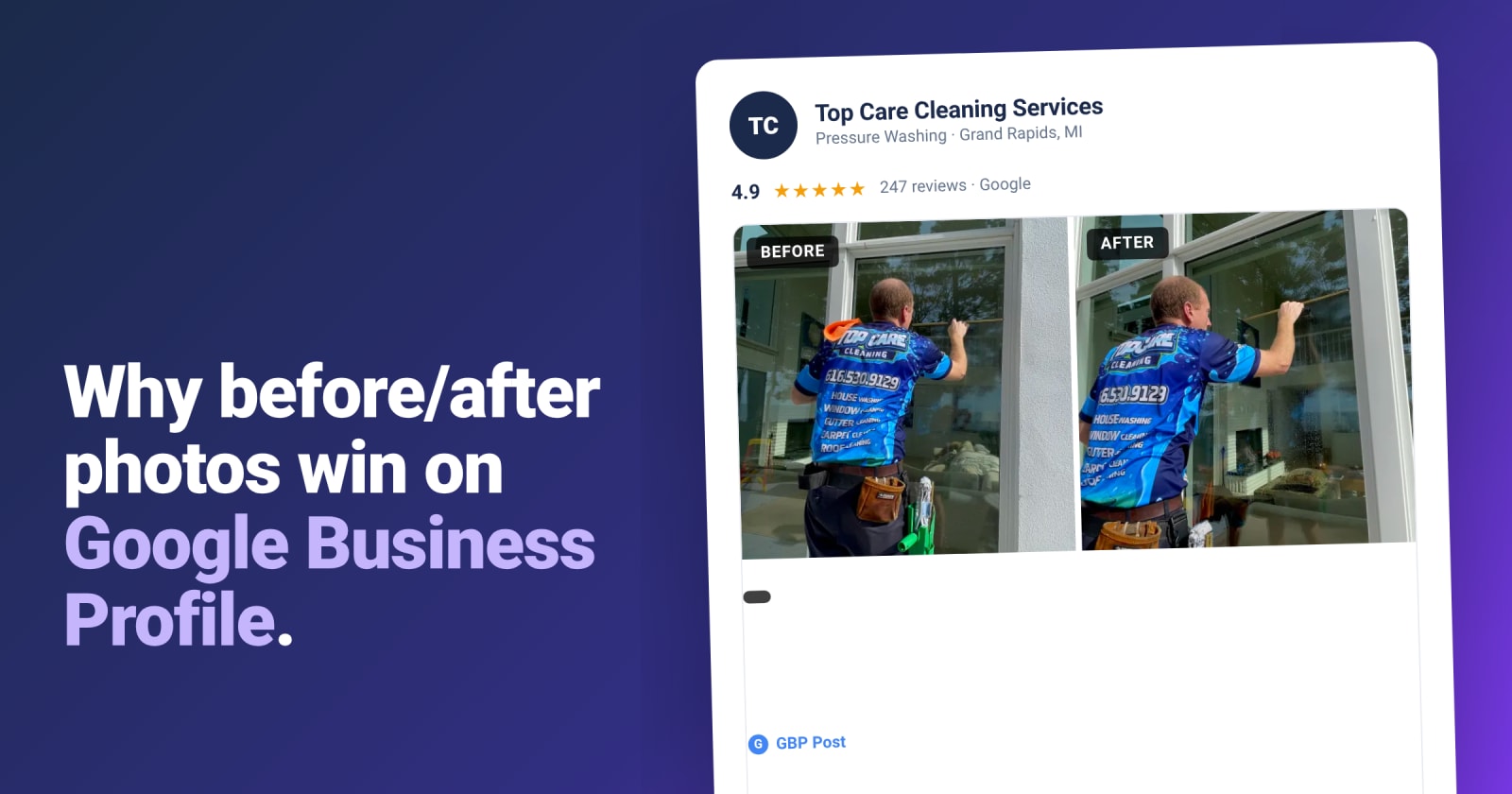
Google Business Profile is the single biggest lever a local service business has, and almost nobody pulls it correctly. The local pack — that map result with three businesses at the top of every "near me" search — is where 80% of prospects look before they call. And the single biggest signal that pushes a business into that pack, beyond reviews and proximity, is freshness.
Freshness on GBP is mostly photos. Specifically: photos uploaded recently, of your actual work, from your actual locations. Not stock images. Not your logo. Not a screenshot of a five-star review. Photos of jobs.
And the format of photo that converts hardest? Before/after composites.
Why before/after wins where a single photo doesn't
A single "after" photo of a sparkling kitchen is fine. A single "before" photo of a dirty kitchen is depressing. Together, in one image, they tell a story in less than a second — and stories are what make a prospect stop scrolling and tap "call."
A before/after photo does three things a single photo can't:
- Implicit testimonial. The customer didn't have to say "Top Care did a great job." The photo says it. The contrast itself is the proof.
- Pattern interrupt. Eyes pick up the split-frame instantly. In a scrolling local-pack carousel of stock images and logos, a real before/after stops the thumb.
- Imagination trigger. The prospect doesn't have to wonder "what would this look like for my house?" They see it.
This isn't a marketing-blog theory. We ran this at Top Care Cleaning Services for two years before we built Hosted Proof. The posts with before/after composites get 2–4x the impressions of plain after-only photos on GBP. Same business, same crew, same job. Different format. Different result.
Real examples by service vertical
Cleaning
The classic. Same kitchen, same angle, before and after. Grease vent hood, oven interior, grout. The dirtier the before, the better the conversion — because the contrast is sharper.
Landscaping
Overgrown to manicured. Bed before mulch, bed after mulch. A leaf-covered yard, then the same yard cleared. Time-of-year matters: the same lawn in November vs. May tells a different story than the same lawn one day apart.
HVAC
HVAC is harder for before/after, but it works for clogged condenser coils, rusted air handlers replaced with new equipment, ductwork before/after cleaning. The "after" image alone doesn't impress; the contrast does.
Roofing
Damaged shingle close-up vs. new shingle. Drone shots of full-roof before/after are killer when you have them, but a tight close-up of damaged section vs. repaired section works in 80% of cases.
Plumbing
Corroded pipe vs. new pipe. Clogged drain vs. clear drain (with a flashlight shot down the line). Old water heater vs. new water heater.
How to shoot them right
The format only works if the photos look like the same shot. Three rules from doing this hundreds of times:
Same angle, same distance
The single biggest mistake: shooting the "before" from one corner of the kitchen and the "after" from the opposite corner. The eye can't track the change. Stand in the same spot, hold the phone at the same height, point it the same way. Marking the floor with a piece of tape is not crazy.
Same lighting
Don't shoot the "before" with the light off and the "after" with three lamps on. The contrast then is just lighting, not work. Either both natural light, or both artificial. Phones do their own auto-exposure, which actually helps here — just don't change the light source between shots.
Wide enough to show context
A zoomed-in shot of one tile vs. one tile doesn't communicate as well as a wider shot showing the whole bathroom floor. Wide enough that the viewer can orient themselves and recognize what they're looking at.
How often to post
Google's local-pack algorithm rewards consistency more than volume. Two before/after posts a week, every week, for a year beats twenty in one week and nothing for two months.
At Top Care we aim for 3 before/after posts per week to GBP. We didn't always hit that. The single biggest reason we missed: the techs took the photos, but nobody got them out of the techs' phones and onto GBP fast enough. By Friday the photos were stale and posting them felt weird.
That's the entire reason we built Hosted Proof. The tech snaps it on the job, the photo lands in the approval queue, the owner taps approve, and it's on GBP, Facebook, and Instagram before the next job starts. No more "I'll get to it Friday." Friday never comes for the operator who's actually running the business.
The "social media test"
Before you publish a before/after, ask: would a stranger scrolling past this stop and look?
If the answer is no — the contrast isn't strong enough, the framing is weird, the lighting kills it — don't post it. Better one strong before/after per week than five weak ones. The strong ones build a body of work that prospects can scroll. The weak ones dilute the signal.
The good news: once you've done a few dozen, the eye gets fast. You'll know in 2 seconds whether a pair is worth publishing.
Why this is hard to do consistently — and what Hosted Proof does about it
Every operator we've talked to about this gives the same answer when asked why their GBP doesn't have more before/after content: "the techs take the photos, they just don't make it to me." Sometimes the techs forget. Sometimes the photos sit in iMessage with the owner and never make it to GBP. Sometimes the owner gets to them on Sunday night and posts five at once, which looks weird in the timeline.
Hosted Proof fixes that workflow. Tech snaps both photos from the job site. They land in the owner's approval queue with the AI-drafted caption already written. The owner taps approve. The composite, the watermark, the GBP post, the Facebook post, the Instagram post — all of it happens automatically. Total time for the owner: about 5 seconds per post.
The single biggest unlock isn't the AI or the multi-platform publishing. It's that the photo stops dying on the tech's phone.